If you’re buying workwear for a team in the UK, you’ll hit this question sooner or later:
“What counts as PPE… and what do we actually have to provide?”
“PPE” gets thrown around like it’s just another uniform line item. But it isn’t. If a risk assessment says PPE is needed, you don’t get to treat it like an optional add-on. HSE is clear that employers must protect workers from health and safety risks and provide PPE free of charge if the risk assessment shows it’s needed.
Let’s go through it properly, in plain English.
What PPE actually means (and what qualifies)?
PPE stands for Personal Protective Equipment. The simplest way to think about it is:
PPE is anything worn or used specifically to protect someone from a health or safety risk at work.
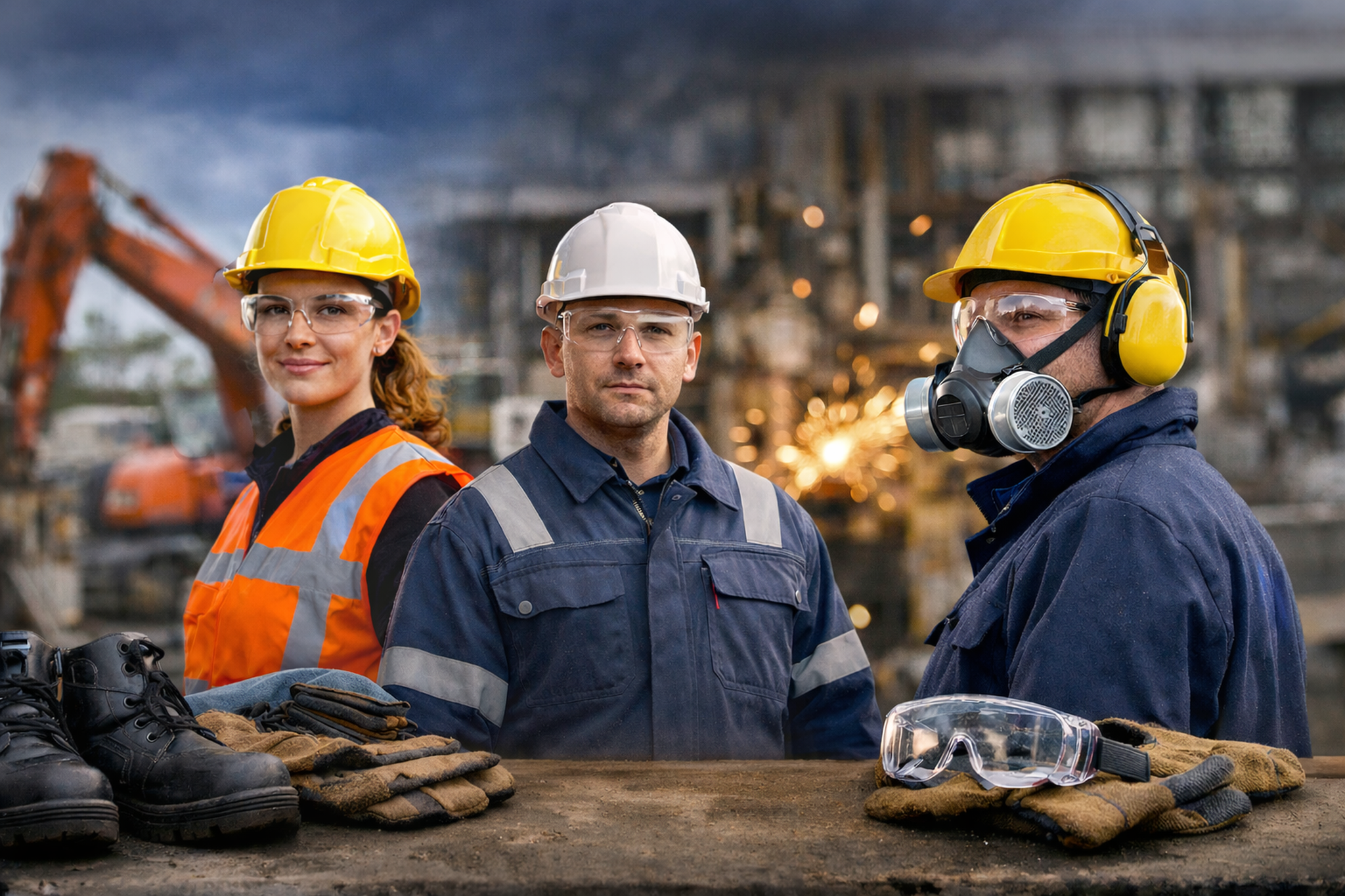
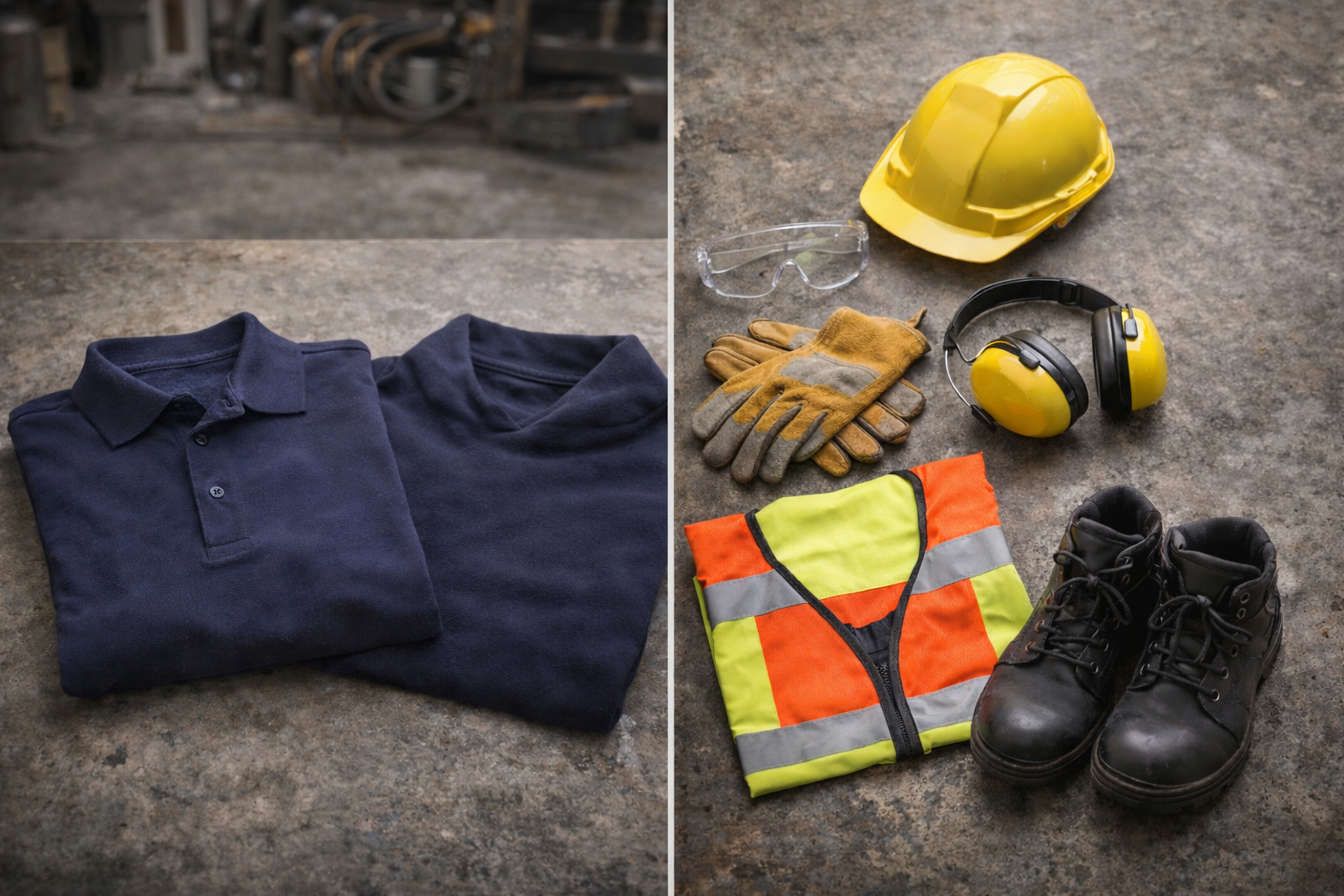
HSE gives straightforward examples of what counts as PPE, including:
- safety helmets / hard hats
- gloves
- eye protection
- hearing protection
- high-visibility clothing
- safety footwear
- safety harnesses
- RPE (respiratory protective equipment) to protect from breathing in dust, mist, gas, or fumes
What doesn’t count? Ordinary clothing that’s not designed to protect against a hazard. A branded hoodie might be brilliant workwear, but it isn’t PPE unless it’s actually designed and rated for protection.
This matters because when something is PPE, it comes with employer duties. When it’s just uniform, it doesn’t carry the same legal expectations.
Workwear vs PPE (why this mix-up causes problems)
Workwear is about the job: comfort, durability, pockets, warmth, looking professional, and yes – branding.
PPE is about the risk: it exists because something could hurt someone.
So if your team works in an office and wants branded polos, you’re in “uniform” territory.
If your team works around vehicles, cutting tools, dust, noise, falling objects, chemicals, heat, flame, or working at height… now you’re likely in PPE territory, and you need to start with the risk assessment.
The HSE principle most people miss: PPE is the last resort
This catches good employers out because PPE feels like the obvious solution.
But HSE’s approach is: control the risk properly first. PPE is used when hazards still remain after you’ve applied other controls (engineering controls, safe systems of work, etc.).
So the right starting point isn’t “what hi-vis do we buy?”
It’s: “What risks are we trying to control, and what controls are already in place?”
Once you’ve done that, PPE becomes much easier to get right.
What employers have to do (in reality)
Here’s the part people don’t love, but it’s the truth:
If the risk assessment says PPE is needed, HSE says employers must provide it free of charge.
But buying it is only step one.
You also need PPE that’s actually suitable for the job, fits the person, and is used properly. That means information, instruction/training, and making sure it’s maintained and replaced when needed. If PPE is damaged, worn out, faded, or “kind of works”, it’s not doing the job you’re relying on it to do.
Hi-vis: what the “Class 1 / 2 / 3” label really means
Hi-vis is one of the biggest areas of confusion because it looks like simple workwear. People treat it like a vest you throw on.
But hi-vis is PPE when it’s being used to control a visibility risk around moving vehicles or plant.
HSE explains the label like this: compliant hi-vis clothing shows a pictogram with two numbers:
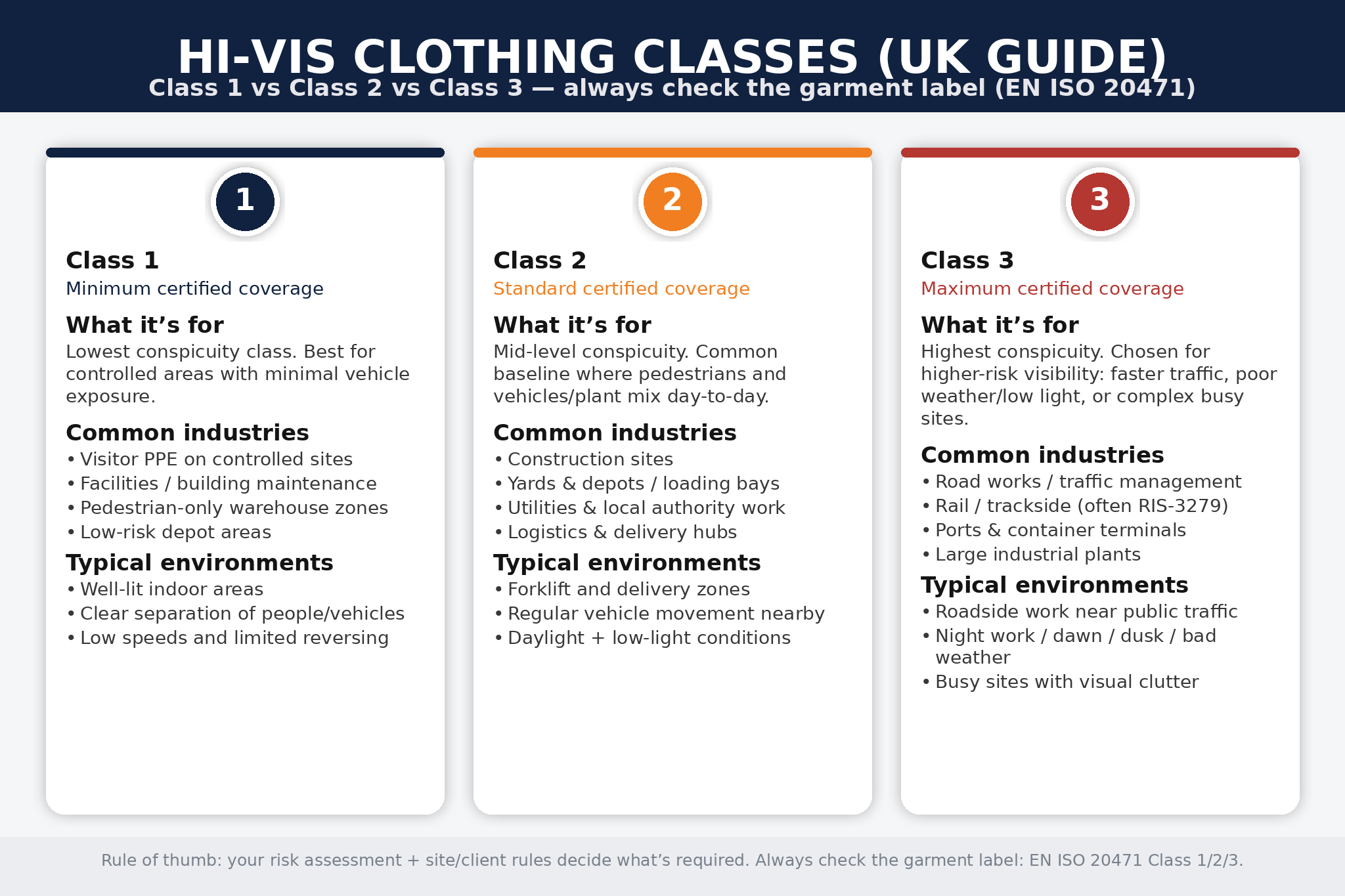
X = the class of conspicuity (how much hi-vis material is on the garment). Class 3 is best, Class 1 is lowest.
Y = retroreflection performance (how well it reflects in headlights). Class 2 is more visible than Class 1 at night.
Now the bit you actually asked for:
When to use Class 1?
Class 1 is for lower-risk, controlled environments, where vehicle exposure is minimal and speeds are low.
It’s the sort of level you might accept when people are mostly separated from vehicles, the area is well-lit, and the “being seen” risk is relatively low.
If your team is regularly mixing with forklifts, loading bays, reversing vehicles, or site plant, Class 1 is usually not where you want to stop.
When to use Class 2?
Class 2 is the common “site standard” for general environments where pedestrians and vehicles/plant are working in the same space.
Warehouses, yards, construction sites, delivery environments, facilities work – anywhere you’ve got regular vehicle movement and people on foot in the same zone, Class 2 is often the practical baseline (unless the site/client specifies otherwise).
When to use Class 3?
Class 3 is for higher-risk visibility situations, where being seen late has serious consequences. That typically includes:
- higher-speed vehicle exposure
- working in darkness, dawn/dusk, or poor weather
- complex environments with lots of visual “clutter” (traffic, lighting, reflective backgrounds)
- situations where maximum body coverage helps drivers spot someone sooner
In plain terms: if the environment is busy, fast, dark, or unforgiving, Class 3 is the “go higher, be safer” choice.
One important detail: sometimes it’s the combined outfit that achieves the overall visibility level, not just one garment. So when a site says “Class 3 required,” they usually mean “the worker must present Class 3 conspicuity overall,” not “any random item with a Class 3 label.”
And to be crystal clear: HSE explains what the classes mean on the marking. What you must wear on a specific site is typically driven by your risk assessment and site/client rules.
Branding hi-vis without wrecking the point of it
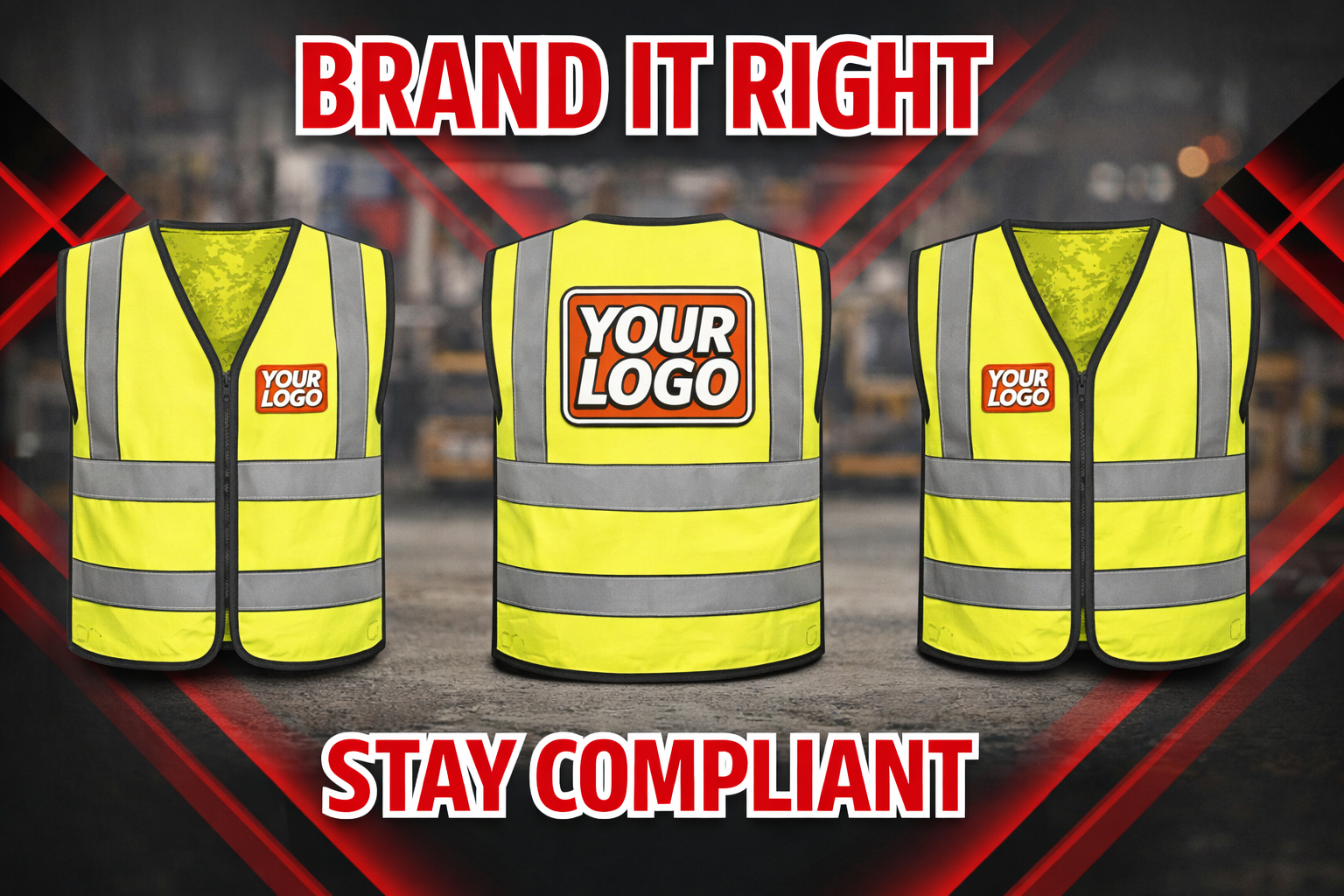
You can brand hi-vis. Most companies do.
The line you can’t cross is simple: don’t reduce the garment’s ability to do its job.
In practice, that means you don’t cover reflective tape, you don’t place huge prints that remove key visible panels, and you keep decoration in safe zones, so the garment still performs the way it’s meant to.
Flame Retardant (FR) workwear: where “thicker” doesn’t mean “safer”
FR is where people make expensive mistakes, because the clothing looks normal until you check what it’s actually rated for.
If your risk assessment includes exposure to heat, flame, or molten metal splash, you need protective clothing that’s tested for that hazard. HSE specifically notes that BS EN ISO 11612 is the standard clothes will usually be tested to in this area, and that garments are labelled with performance levels to help you choose what’s correct for your team.
So rather than guessing based on “heavy fabric” or “it’ll probably be fine,” you look at the label and match the protection to the real hazard.
The part most people forget: branding can be the weak point.
Even if you buy the correct FR garment, the wrong decoration method can cause issues in the real world.
If you’re putting logos on FR kit, treat it like a specialist job. The goal is simple: decorate it without compromising performance.
The common mistakes we see (that cause reorders and headaches)
Most problems aren’t caused by bad intentions. They’re caused by reasonable assumptions:
- treating PPE as “done” once it’s purchased
- issuing the wrong fit, so it doesn’t get worn properly
- assuming all hi-vis is the same, when classes and coverage vary
- keeping faded/damaged PPE in circulation
- branding specialist garments without checking “safe zones” and suitability
If you want the simple next step
If you’re not sure what class of hi-vis you need, or whether something counts as PPE, don’t guess. Start with the environment and the risk.
If you tell us what the job is, where it’s being done (warehouse, site, roadside, yard), and any site/client rules you’re working under, we can point you to the right hi-vis level and make sure the branding setup doesn’t compromise the garment.
That’s how you avoid ordering twice.