Just Cool By Awdis!Just Cool by AWDis are the biggest activewear brand in the printed garment industry. Offering a great range of items designed for active performance, from material to cut, they also have a fantastic range of colours and sizes. Teamed up with our decorating expertise, they’re the best way to Look Cool, Feel Cool, Stay Cool!
Just Hoods By Awdis!Just Hoods began life selling one style of hoodie…the best hoodie you could imagine! Since then they have grown their range to include other casual styles such as hoodies, jumpers, jogging bottoms and jackets. They now offer 68 styles in 101 colours- guaranteed to have just the garment you need.
Branded Workwear Cost In The UK: What You Actually Pay In 2026
One of the first questions potential workwear buyers want to know is:
“How much does it cost?”
And honestly… fair enough.
If you are about to kit out a team with branded clothing, you don’t want to fall in love with the idea and then find out it’s wildly outside budget. The tricky part is that branded workwear pricing can be a bit like asking:
“How much does a car cost?” or “How much does a house cost?”
Because the answer is always: it depends.
You can buy the basics. You can upgrade everything. You can go premium. You can keep it simple or add every logo placement under the sun – and all of that changes the price.
So, while we can’t give one magic number that applies to everyone, we can do something much more helpful, we can explain the general pricing guidelines, what makes costs go up or down, what most businesses actually spend, and why some suppliers are cheap while others are… well… not.
Why branded workwear pricing varies so much?
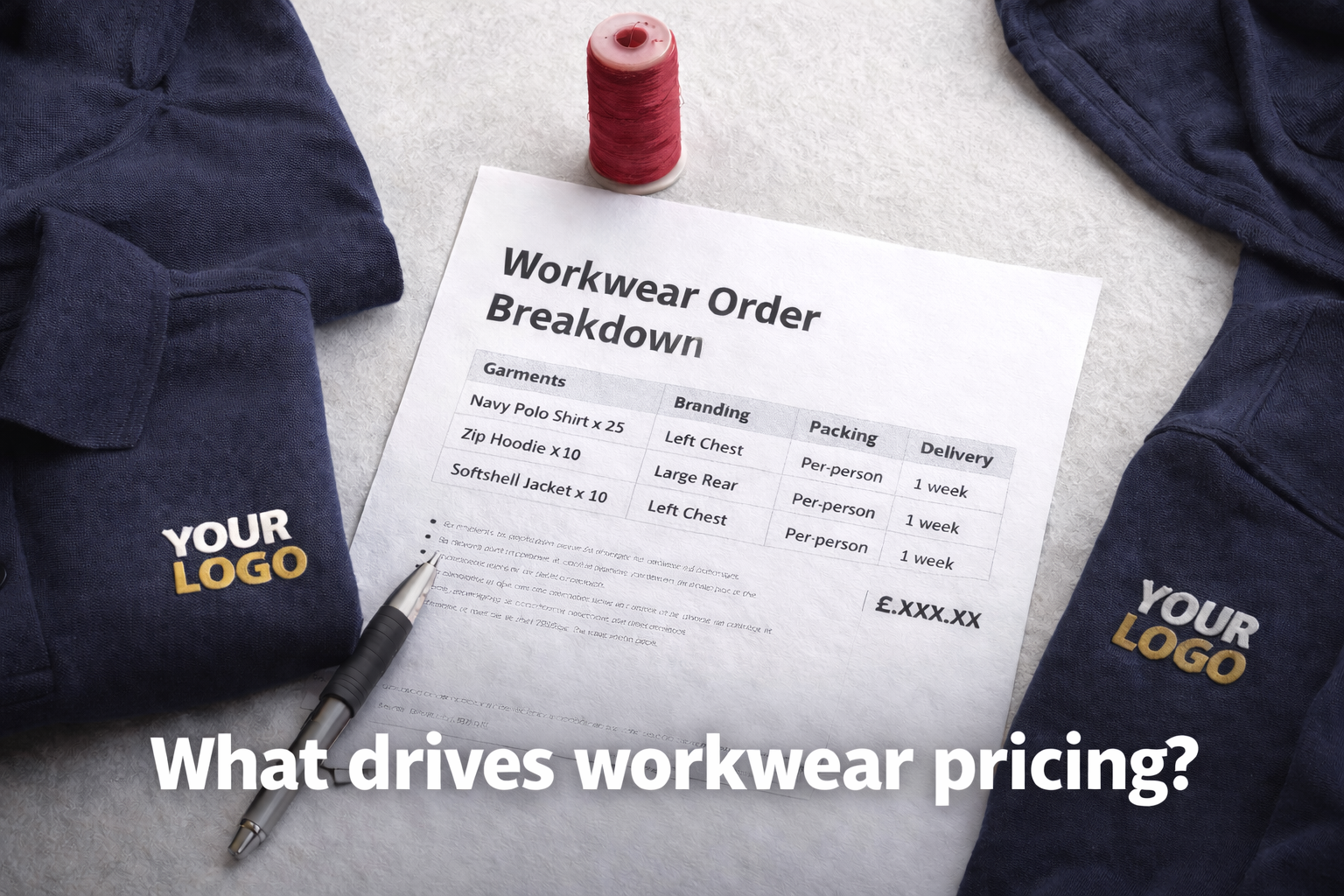
Branded workwear is made up of two main parts, the garments themselves (polo shirts, hoodies, jackets, trousers, hi-vis, etc.) and the branding (embroidery, print, logo placement, name personalisation).
The range comes from the fact that you can mix and match both parts in hundreds of ways. A “simple” order might be 10 standard polos with a small chest logo. A more involved order might be 60 premium jackets, embroidered front and back, plus individual names and job roles.
Both are branded workwear… but they are completely different orders.
What makes branded workwear cost more?
When people think “workwear pricing”, they often picture a hoodie with a logo and assume it’s basically the hoodie price plus a small extra.
In reality, pricing jumps for a few predictable reasons, and once you know them, most quotes start to make sense.
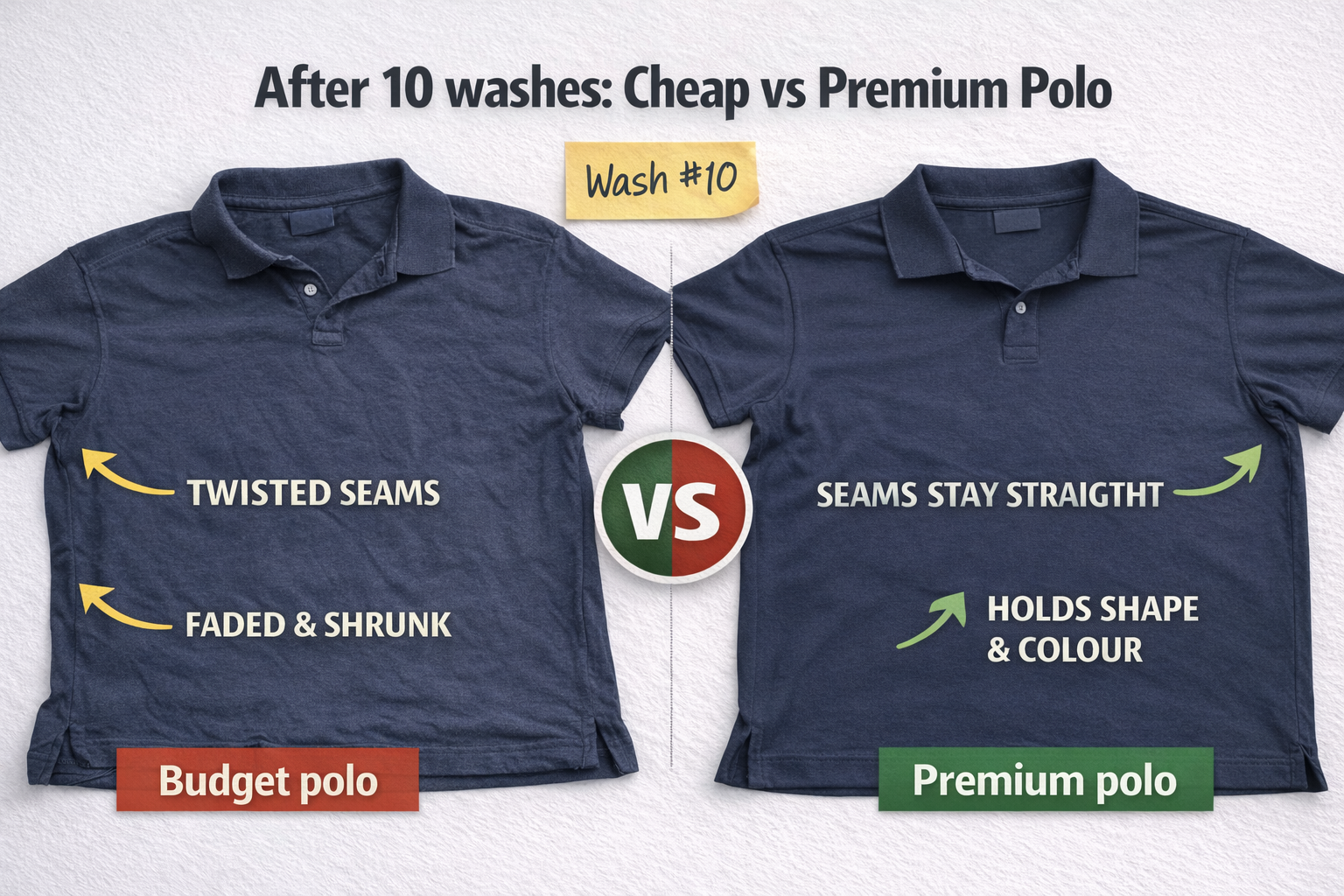
The first big one is the garment itself. A £6 polo and a £20 polo can look nearly identical in a product photo, but they behave very differently after ten washes on a real person doing a real job. Better workwear tends to mean stronger stitching, more consistent sizing, better fabric weight, less shrinkage, fewer twisted seams, and zips that don’t fail after a month. If your team wears their kit hard – warehouse, construction, manufacturing, facilities, landscaping – garment quality becomes the difference between “fine for a year” and “why are we reordering already?”
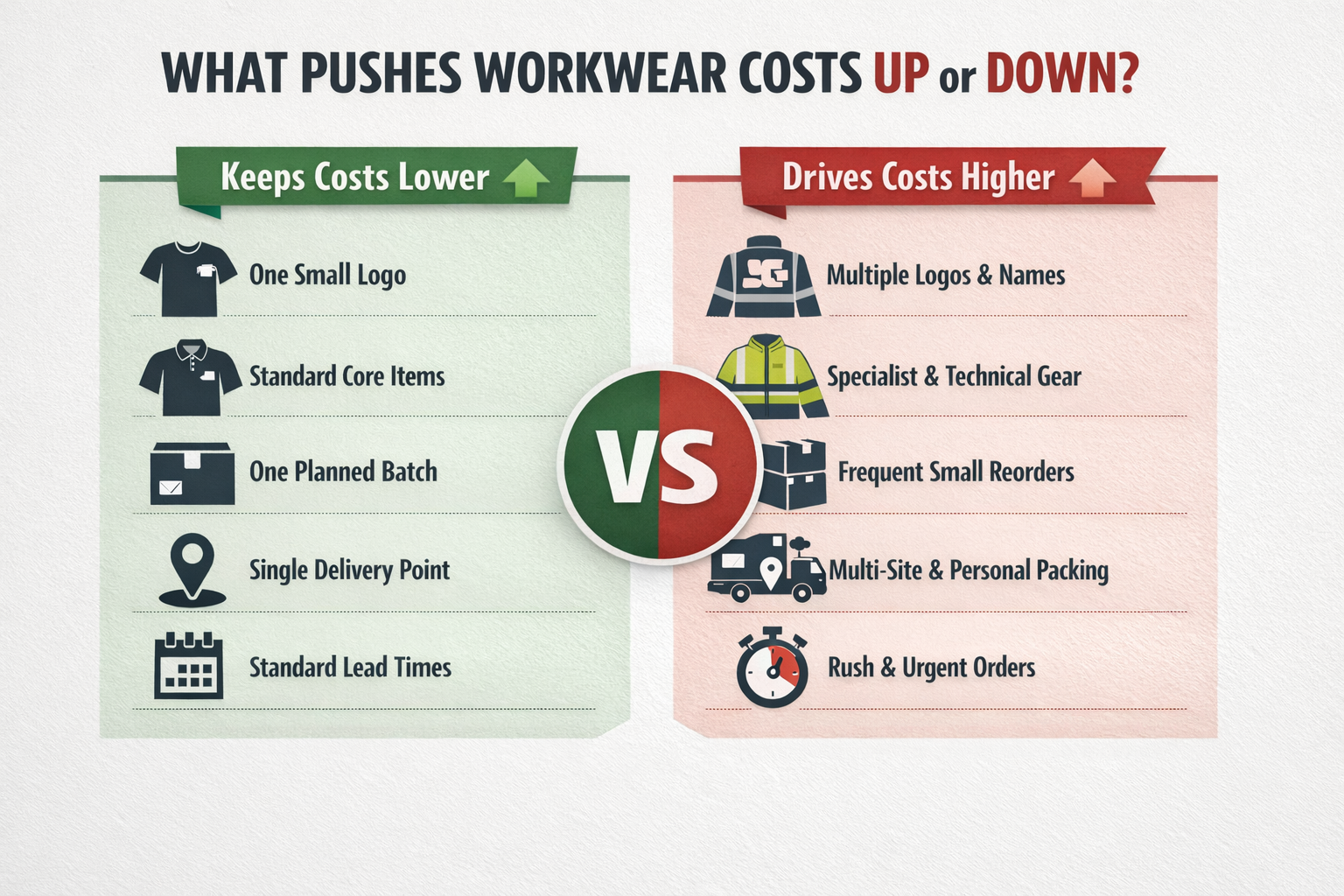
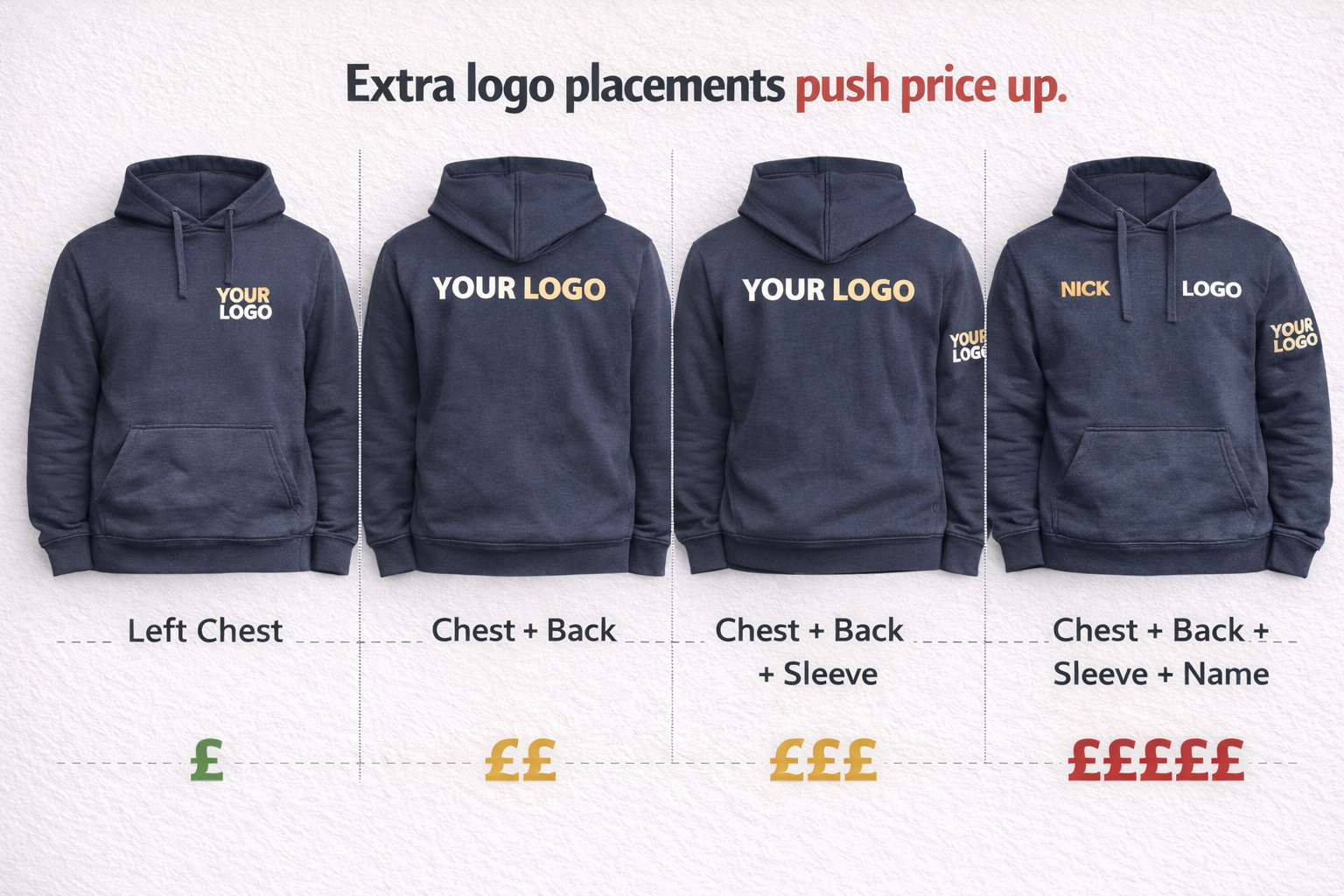
The second big cost driver is what you’re asking the branding to do. A single left-chest logo is usually the simplest and most cost-effective option because it’s quick to apply and doesn’t require much setup beyond the first time. But prices climb fast when you add more placements and more complexity. A large back logo, sleeve branding, adding names, adding job roles, or having multiple logo positions per garment all add time and setup.
Then there’s the branding method itself. Embroidery is often seen as the “premium” option, but it isn’t automatically the right choice for everything. Embroidery cost is heavily influenced by stitch count, which basically means how detailed the logo is and how long the machine has to run. A simple logo can be very reasonable. A detailed crest, tiny text, or lots of fine lines can push it up more than buyers expect.
Print pricing can be lower or higher depending on what type of print it is and what the design needs. Big, bold logos can be very efficient to print, especially at scale. Highly detailed multi-colour designs can also be printed well, but the cost depends on how they’re produced and the volumes.
Finally, there’s speed and logistics. If you need everything next week, you often pay extra because production gets reshuffled. And if you need uniforms split by person, bagged and labelled, or shipped to multiple sites, that’s real labour and handling. Some suppliers bake that in; others charge it separately. Either way, it affects the total.
How to reduce branded workwear cost?
If budget is the main pressure, there are absolutely ways to reduce spend without the whole thing looking “cheap”. But most cost reductions come with trade-offs, and it’s better to choose those trade-offs deliberately than discover them later.
One of the simplest ways to keep costs down is to standardise. The more you can reduce “choice chaos”, the cheaper and smoother the whole process becomes. A tight core range – say two tops, one outer layer, one trouser option – will almost always be more cost-effective than letting everyone pick from twelve items.
Branding choices can reduce cost too. Sticking to one logo position, keeping logo sizes sensible, and avoiding personalisation everywhere will bring the unit price down quickly. Names look great in some environments, but they also add cost per item and can complicate reordering when staff turnover is high.
Print can also be a cost reducer in many situations, especially for larger logos and higher volumes. The trade-off is that durability varies depending on how items are washed and what kind of print method is used. A good supplier will guide you honestly here because “cheap print” that cracks after a few washes is not a saving.
Finally, ordering strategy matters more than people realise. A single bulk order is usually cheaper per item than many small top-up orders. If your business is constantly doing emergency orders for new starters, you may not need “cheaper garments” as much as you need a better system – like holding a small amount of common sizes or setting a monthly ordering cycle.
Why some workwear suppliers are more expensive?
If you’ve shopped around, you’ve probably noticed that some quotes are wildly higher than others.
Often, higher-priced suppliers have things like stock holding, in-house branding, professionally digitised files, and more reliable turnaround times. Some provide designated account support, better quality control, and more consistent branding results from one run to the next.
In other words, the extra cost isn’t always “profit” – it’s often what’s required to deliver speed, quality, consistency, and fewer headaches.
Why some suppliers are so cheap?
On the other side, cheaper quotes often come from businesses that are essentially acting as middlemen – drop shipping garments, outsourcing branding, and relying on long lead times.
Sometimes the garments are lower grade. That might mean shrinkage, fading, seams failing, bobbling, or sizing that changes from one order to the next. If you’re buying for a team, inconsistency creates constant admin: returns, complaints, swaps, and repeat orders.
Sometimes the branding is where corners get cut. Poorly applied prints can crack, peel, or feel like plastic. Embroidery can look messy if the digitising is rushed or the garment isn’t suitable for that stitch style. And if quality control is light, you can end up with logos drifting position, colours looking off, or different sizes of the “same” logo on different garments.
Cheap workwear can be perfectly fine in certain contexts. The problem is that “cheap” often comes with hidden costs that don’t show up until after the delivery arrives.
Is it worth paying more?
This is the question sitting behind most pricing discussions, even if nobody says it out loud.
Branded workwear is usually worth it when it solves real problems: you want your team to look like one business, you want customers to recognise staff, you need safety visibility, or you’re trying to stop uniforms turning into an admin nightmare.
But it’s not worth overspending when your team barely wears it, or when the work destroys clothing so fast that any “premium” option gets shredded anyway. In those cases, the smarter move may be choosing mid-grade items and planning replacements rather than buying the highest spec possible.
The sweet spot for most businesses is not “cheapest” or “most premium”. It’s “durable enough, comfortable enough, easy to reorder, and consistent across time”.
How much does LJ Workwear charge?
Here’s the part people really want: a realistic range.
LJ Workwear tends to sit in the mid-market to premium end, depending on what you choose. Not because “premium sounds nice”, but because many buyers want the same thing: clothing that lasts, looks consistent across a team, and can be reordered reliably without drama.
Most LJ Workwear customers fall into one of these brackets:
Small businesses typically spend £100-£200, depending on garment quality and how many pieces they’re ordering.
Mid-size companies tend to land around £500-£1,000, again depending on quantity, garment choice, and branding complexity.
Larger bulk orders usually sit around £2,500+ especially when you’re doing full team rollouts, multiple garments per person, or premium outerwear. For bigger organisations or multi-site uniforms, it is not unusual for orders to go well beyond that.
These ranges aren’t “sales talk” – they’re simply what we see day to day. The main driver is always the same: quality + quantity + branding detail.
That said, workwear pricing only becomes meaningful when you anchor it with ranges. So, here are typical per-item UK ranges that include garment plus small branding in common scenarios such as left chest. Think of this as calibration, not a fixed price list.
Item (branded) | Typical Price Range
T-shirt
£8-£18
Polo Shirt
£12-£35
Hoodie/Sweatshirt
£15-£55
Fleece
£25-£55
Softshell Jacket
£35-£90
Hi-viz Vest
£8-£22
Hi-viz Jacket
£35-£160
Work Trousers (often unbranded)
£20-£70
The pricing questions we get asked most!
To round this off, here are a few questions we hear constantly – and you’re probably wondering them too.
Do you have minimum order quantities?
No – we don’t have a minimum order policy. Whether you need one item or one hundred, we can help. The only thing that changes is the price per item: smaller orders can cost a bit more per garment because setup and production time are spread across fewer pieces, while larger orders usually work out better value per item.
Are there logo setup fees?
Sometimes – only if we don’t already have your logo on file. If you can supply print-ready artwork (vector files like AI/EPS/PDF) or an embroidery-ready DST/EMB file, there’s usually no setup fee. If you don’t have ready-to-go files, we’ll create what’s needed (for example, digitising the logo for embroidery or preparing it properly for print). In that case, a one-off setup fee applies. The good news: once it’s done, we keep your logo on file, so you won’t pay that setup fee again on future orders – unless your logo changes.
Is embroidery more expensive than print?
Generally, yes. Embroidery takes longer and is more labour/machine intensive – but it’s also usually more durable and gives a premium finish.
Are there shipping fees?
Shipping depends on order size and destination, but we’ll always make that clear upfront.
So… What should you do next?
Right – so what’s the best way to get your exact price?
If it’s a smaller order (a few polos, hoodies, hi-vis bits, that sort of thing), don’t overthink it – just use the website. Pop what you want into your basket, add your branding options, and you’ll see the pricing as you go.
If you’re ordering for 25+ employees, need help choosing the right uniform mix, or want everything consistent across a growing team, that’s when it makes sense to speak to us. We’ll guide you, keep it tidy, and make sure you’re not paying for things you don’t actually need.
To provide the best experiences, we use technologies like cookies to store and/or access device information. Consenting to these technologies will allow us to process data such as browsing behavior or unique IDs on this site. Not consenting or withdrawing consent, may adversely affect certain features and functions.
Functional
Always active
The technical storage or access is strictly necessary for the legitimate purpose of enabling the use of a specific service explicitly requested by the subscriber or user, or for the sole purpose of carrying out the transmission of a communication over an electronic communications network.
Preferences
The technical storage or access is necessary for the legitimate purpose of storing preferences that are not requested by the subscriber or user.
Statistics
The technical storage or access that is used exclusively for statistical purposes.The technical storage or access that is used exclusively for anonymous statistical purposes. Without a subpoena, voluntary compliance on the part of your Internet Service Provider, or additional records from a third party, information stored or retrieved for this purpose alone cannot usually be used to identify you.
Marketing
The technical storage or access is required to create user profiles to send advertising, or to track the user on a website or across several websites for similar marketing purposes.
Good quality work wear and true to size I would definitely use them again
Gareth Jones
Great Quality and Value for Money and will buy more
Jola Designs
The printing quality is excellent. They offer both embroidery and Direct to film options. Highly recommend.
logger
top quality work wear worn at different companies over long period of time
Ian Wilson
Quality service from LJ Workwear. First order & very pleased with the shirts. Keep you updated on orders & good delivery time. Thank you.
Matt Thickett
Fast service, perfect quality, good price - can't recommend LJ enough - Thanks team
Colin Harwood
Excellent service
Cheshire Stove Shop
LJ workwear have provided uniform for staff as well as multiple garments for the local gym I attend. Always quality products that fit my taller frame well and wear brilliantly even after hundreds of washes.